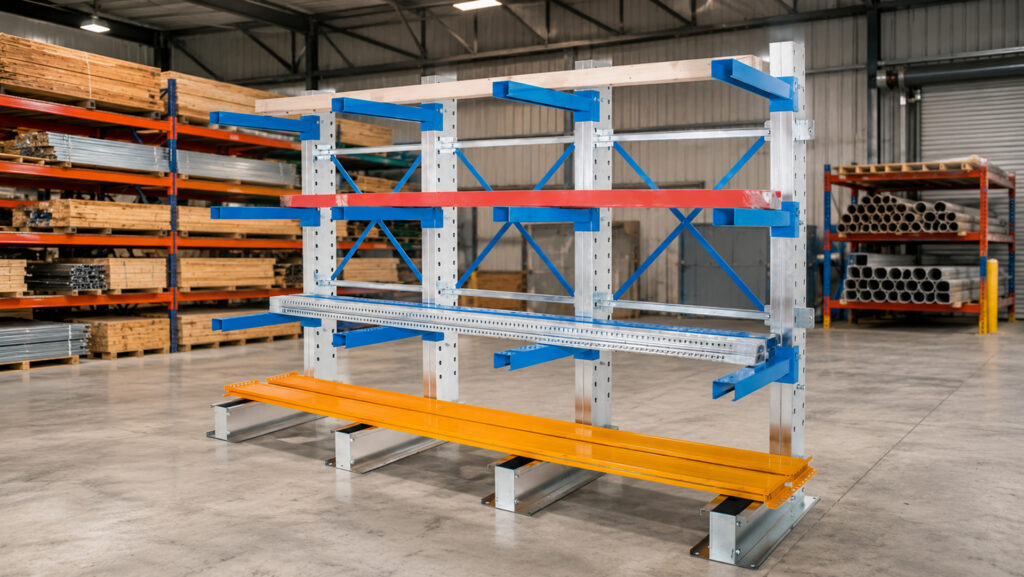
If you have ever tried to store lengths of timber, tube, extrusion or sheet material on ordinary pallet racking, you already know why cantilever racking exists. The front uprights of standard racking get in the way of long loads. Cantilever racking does away with them, so you can load and unload full lengths from the front without fighting the frame.
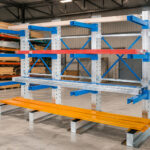
Cantilever racking stores long, awkward or continuous loads: timber, steel tube and box section, plastic pipe, extrusions, sheet materials and board. Instead of beams between two uprights, it has a row of columns with arms projecting out from one or both sides. The load rests across the arms, and because there is no upright at the front of each bay, a forklift or a person can load the full length cleanly.
You can see the system and its components in our cantilever racking range. For sheet and panel storage specifically, it is the natural choice over beam racking.
Single-sided cantilever racking sits against a wall and loads from one side, which suits a perimeter run. Double-sided racking stands in open floor and loads from both sides, which gives you the most storage per square metre of floor. Which you choose comes down to whether the racking is going against a wall or standing free in the middle of the space.
Two things decide whether cantilever racking works for you: the arm length and the load rating. The arms need to be long enough to support your material without it overhanging dangerously, and the whole system needs to be rated comfortably above the weight you will store per arm and per column. As with any racking, base the design on your real loads and building rather than guessing, and factor in how you will load it, by hand, by forklift or by side loader.
If some of your stock is palletised rather than long, you will likely want pallet racking alongside it, and for smaller vertical loads a vertical storage rack may be enough.
Cantilever racking carries heavy, long loads that can be dangerous if they shift or overload an arm. Clear load signage, sensible loading practice and regular checks for damage keep it safe. If a forklift clips a column, get it inspected rather than carrying on and hoping.
What is cantilever racking best for?
Long, awkward or continuous loads such as timber, tube, pipe, extrusion, sheet material and board, which do not sit well on standard pallet racking.
What is the difference between single and double-sided cantilever racking?
Single-sided loads from one side and suits placement against a wall. Double-sided loads from both sides and gives the most storage per square metre when standing in open floor.
How much weight can cantilever racking hold?
It depends on the column and arm specification. The system should be rated comfortably above your heaviest load per arm and per column, based on your actual materials.
Can I store sheet material on cantilever racking? Yes. Sheet metal, board and panels are a classic cantilever application because the open front lets you load full sheets without a front upright in the way.